

How To Enhance Your Valuation Multiple
A business valuation multiple measures an acquirer’s confidence in your company’s potential future earnings. The secret to enhancing your multiple is simple: reducing perceived risk for achieving future cash flow. A professional valuation considers these factors in determining the value.
At Chaffe & Associates, our credentialed business valuation professionals provide a comprehensive process applying the most thorough business valuation guidelines including the Statement on Standards for Valuation Services and Uniform Standards of Professional Appraisal Practice.*
Informed by “The Chaffe Difference,” our firm evaluates your organization’s growth outlook, operational processes, and market position to assess your business as a strategic investment. We can help you to determine your highest possible succession alternative, navigate estate planning and gift transfers, and understand the possible sales price. Continue reading to learn more about how to enhance your valuation multiple.
At-A-Glance
- Risk Reduction is Value Creation: The core strategy for maximizing your multiple is eliminating buyer risk. This is achieved by making your financial and operational performance completely clear, auditable, and trustworthy during due diligence.
- Recast Your Earnings: Ensure your financials reflect true, sustainable profitability. You must proactively normalize EBITDA by removing all personal, non-recurring, and inconsistent expenses to show the maximum sustainable profit.
- Build Transferable Value: Buyers pay a premium for a business that can run without the owner. This requires operational independence by building a capable management team, documenting all systems (SOPs), and proving strong, recurring revenue streams.
Table of Contents
What is the Valuation Multiple?
Financial health & due diligence readiness (risk reduction)
What drives higher valuation multiples?
Market position and future growth potential
Contact Chaffe
What is the Valuation Multiple?
The business valuation multiple is a valuation metric used to estimate or express your business’ value. It illustrates the market’s willingness to pay for each dollar of your company’s earnings or revenue.
In practice, valuation multiples are applied to key financial metrics—most commonly cash flow (typically Earnings Before Interest, Taxes, Depreciation, and Amortization, or “EBITDA”) or revenue—to estimate the value of a business.
For example, a 5x EBITDA multiple means a buyer is willing to pay five times the company’s annual EBITDA. This multiple reflects the buyer’s assessment of the risk and sustainability of the company’s future earnings.
However, valuation multiples must be applied in the proper context. A common misunderstanding arises when interest-bearing debt is not considered correctly. Multiples applied to EBITDA or revenue produce Enterprise Value, which represents the total value of the business before debt.
What the owner ultimately receives is the equity value, which is the enterprise value less any outstanding debt. In other words, debt must be paid off at closing.
For example, if a company receives a $100 million offer but has $60 million of interest-bearing debt, the owner’s net proceeds are $40 million, not $100 million.
Is there a single multiple to use for business valuation?
No, there is not one single multiple or formula that applies to every business. The multiple used to value a company is a custom calculation that changes based on quantitative and qualitative factors. The industry-specific multiple is based on the following:
- growth
- industry
- firm size
- economic conditions
A Chaffe valuation professional evaluates a company through a detailed analysis of its historical and pro forma financial performance, as well as its underlying risk and growth characteristics. Market benchmark multiples serve as a reference point and are then adjusted to reflect company-specific factors such as earnings quality, growth prospects, customer and industry risk, and overall financial reliability. Companies with strong, sustainable growth and lower risk profiles generally support higher valuation multiples than businesses with inconsistent financial performance or greater exposure to economic uncertainty.
Financial health & due diligence readiness (risk reduction)
For a sale transaction, one of the key ways to increase your multiple is to make your finances easy to understand and trustworthy. Buyers fear hidden problems. Preparing for due diligence is key in the risk reduction process. “Clean up” your financial records by removing personal expenses and fixing any confusing transactions especially intercompany transactions between related entities.
Proactively addressing legal and regulatory matters helps mitigate compliance risk and reduces the likelihood of undisclosed issues surfacing during due diligence. When a company’s financial and legal position is well documented, defensible, and fully auditable, buyer confidence increases—minimizing transaction friction and lowering perceived acquirer risk.
Recast your financials to enhance your multiple
To present the true profitability and cash flow of your business, financial statements should be recast to remove items that do not reflect ongoing operations. This process involves eliminating personal, non-recurring, and discretionary expenses embedded in the income statement—such as personal vehicle leases or above-market compensation—that a new owner would not be expected to incur.
Recasting also includes correcting confusing or inconsistent intercompany transactions so they reflect arm’s-length, market-based terms. By normalizing the cost structure and clarifying related-party activity, the financials present a cleaner, more accurate picture of sustainable earnings.
When profits are clearly supported, repeatable, and well documented, buyer confidence increases, due diligence friction is reduced, and valuation multiples are better supported.
Strengthen core financial entries and ratios
Buyers examine key financial indicators to judge your company’s stability. To help secure a higher multiple, you need to solidify your Accounting Processes and Policies to ensure all financial entries are consistent and trustworthy. Next, you need to show strong financial ratios.
It is helpful to demonstrate the business generates consistent and sufficient Working Capital (money available for day-to-day operations), and has a healthy Debt-to-Equity ratio (showing you aren’t overly reliant on debt to finance the business).
Reliable metrics instills the buyer with the confidence needed to pay a higher valuation multiple.
Accounting Processes and Policies
Buyers want confidence that your reported earnings are reliable and will continue post-sale. This reassurance comes from having documented accounting processes and policies. Financial management processes help ensure all transactions are recorded correctly, consistently, and on time.
Well-defined policies support that your company’s financials are trustworthy and auditable. These standards can reduce the buyer’s perceived risk during due diligence and eliminate the need for them to spend time and money after a sale. A strong accounting process and system directly enhances your valuation multiple.
Working Capital
Working Capital represents the net current assets that your business has available for its daily operations, found by subtracting current liabilities from current assets. A healthy, positive working capital figure shows a buyer that your company can pay its short-term debts and grow without needing immediate cash infusions.
On the other hand, poor working capital signals financial stress and high risk, which can lower your multiple. By managing or improving this ratio, you demonstrate financial stability and efficiency, making your business a safer and more attractive investment.
Debt-to-Equity
The Debt-to-Equity ratio shows how much of your business is financed by debt versus how much is financed by owner investment (equity). Investors generally want to see a lower ratio or a ratio at industry norms. This illustrates that your company has not operated overly burdened by borrowing.
Unless higher growth or expansion makes it warranted, a high Debt-to-Equity ratio often signals financial risk, as a downturn could make it more difficult to service the debt. As a result, buyers could offer a lower price.
By lowering debt and increasing equity, you confirm the business is financially secure. It also shows how the company is less risky to acquire.
Mitigate legal and compliance risk
Mitigating legal and compliance risk often increases the multiple. Buyers can discount your price if they uncover potential lawsuits, regulatory fines, or unresolved disputes. Proactively confirming you have no outstanding legal issues and that all operations meet industry standards instantly reduces operational risk, and optimizes your valuation multiple.
Pre Due-Diligence Financial Checklist
1. Normalize EBITDA
2. Resolve Intercompany Deals
3. Ensure Healthy Working Capital
What drives higher valuation multiples?
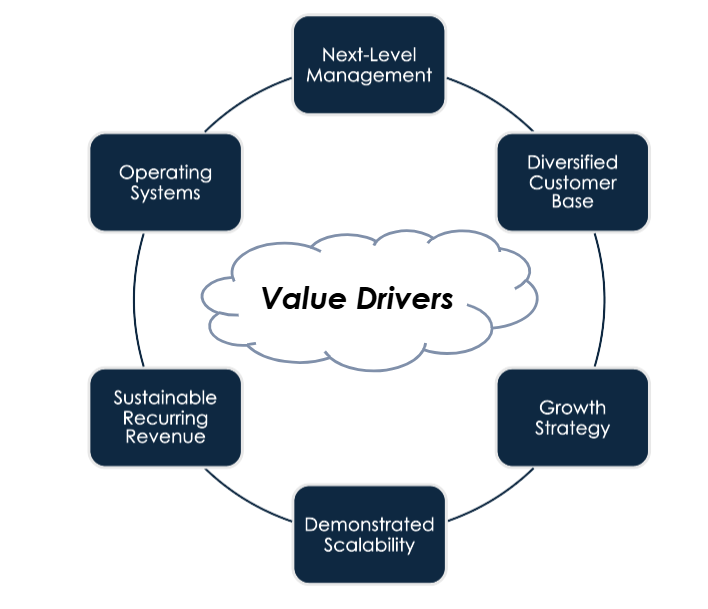
Higher valuation multiples are driven by factors that substantiate whether your business is transferable, scalable, and has strong growth potential. Buyers pay more for a company that can run without the owner and has the opportunity to profitably grow its revenue, and generate cash flow. This includes having strong systems, a great management team, and a path for future success.
Operational effectiveness, transferability, & scalability
Buyers pay a premium for a business that generates “Transferable Value.” This means your company can run efficiently and grow without your constant involvement. By creating a business with operational effectiveness and documented systems, you demonstrate the business may be scalable for new ownership.
Build an independent management team
A business that depends too much on the owner’s personal contacts or skills increases the risk to a buyer. To augment your multiple, you must assemble an experienced, capable leadership team and have successors selected. This shows how the company’s success is not tied to one person. It creates operational independence and makes it more valuable and easier to sell.
Implement strategic planning and governance
Buyers pay more for a business that offers a roadmap for the future. You may consider developing an action-oriented strategic growth plan, and defining Key Performance Indicators (“KPIs”) to measure progress. This structured governance shows a path for future growth.
Create documentation and SOPs
The value of your business jumps when its operations are repeatable. By implementing Standardized Operating Procedures (SOPs) and clear job descriptions, you ensure every process runs consistently. Maintaining efficiency also reduces transition risk and highlights the value of a business’ systems.
Automate and operate lean
Use technology to automate processes and operate lean. The more you control costs and efficiently use labor and assets the better return on invested capital. Achieving a strong ROIC, and similar ratios, supports a higher valuation multiple.
Market position and future growth potential
Buyers typically prefer a company with future growth potential, and factor in the risk of that growth into the valuation. A strong market position, backed by consistent revenue growth, predictable income, and diversified customers, underpins confidence in the outlook for the business.
Demonstrate strong, quantifiable revenue growth
To raise a valuation multiple work on developing a track record of profitable revenue growth. Based on the growth driver correlation, buyers pay more for consistent evidence that your business can meet and exceed its financial targets even after they acquire it.
Identify recurring revenue
Buyers value stable, predictable revenue streams like subscriptions or long-term contracts. This is called recurring revenue, and it often commands higher multiples because it may lead to future income. By developing and highlighting these predictable streams, you can reduce buyer risk.
Improve cash flow and profitability as well as broaden and diversify your customer base
Buyers are focused on your bottom line and stable cash flow. Employ strategies that can reduce costs and improve your operating margins and EBITDA. Along with revenue performance, operating margin may justify a higher valuation multiple.
Buyers see more risk if one customer or a few customers provides too much revenue. Known as customer concentration risk. A broad, diversified customer base serves to lower risk.
Recognize and protect intangible assets to enhance your multiple
Intangible assets are often the most valuable part of your business, even though they do not show up on your balance sheet. You should create, identify and document patents, brand names, and proprietary technology.
Protecting these assets illustrates you have a unique, defensible competitive advantage that cannot be easily copied. Your competitive edge and overall valuation multiple can increase from these intangible assets.
Strengthen competitive advantages and branding
A competitive advantage and recognizable branding may be the platform that convinces a buyer they can grow market share. Developing a set of unique market differentiators and investing in positive name recognition may allow you to enhance your valuation multiple.
Pursue strategic acquisition opportunities
Actively pursuing strategic acquisitions can expand your market presence, acquire new technology, or enhance efficiencies. This creates synergistic growth, where the combined value is greater than the sum of the two parts. Typically, the new combined business becomes valued with a higher valuation multiple than the original business. Learn more about Chaffe’s M&A advisory services.
Contact Chaffe
Interested in how to amplify your valuation multiple with a comprehensive, professional valuation perspective? Contact Chaffe today at (504) 524-1801 or Info@Chaffe-Associates.com to learn more about “The Chaffe Difference” and how we can assist you in maximizing your company value.
About Chaffe
Chaffe & Associates, Inc. (“Chaffe”) provides highly specialized investment banking services to its clients including a full suite of transactional advisory services along with valuations for a multitude of needs. Chaffe leverages both core competencies to create a powerful finance firm that always places its clients first. Founded in 1982, its clients range from sponsors, founder-led and family-owned businesses to publicly traded corporations spanning a broad spectrum of industries. For more information about Chaffe and its leadership team, please visit chaffe-associates.com.

Nene Glenn Gianfala, CPA/ABV, ASA-BV/IA
Senior Vice President, Shareholder
nene@chaffe-associates.com