

Succession Planning Business Valuation
Establishing your business legacy and maximizing owner wealth begins with effective succession planning and a business valuation. At Chaffe & Associates (“Chaffe”), we provide high-quality appraisals that meet the IRS definition of a Qualified Appraisal and adhere to professional standards by the AICPA and ASA. Following our guiding principle of “The Chaffe Difference,” our firm works persistently to help ensure your company’s value is optimized and your financial future is secure for a successful owner transition.
At-A-Glance
- Owner Readiness & Exit Strategy: Effective succession planning begins with an owner readiness assessment to mitigate risk (e.g., customer concentration) and clearly reconcile the determined business value with the owner’s retirement income needs for a secure exit and alternatives.
- IRS Compliance & Tax Strategy: Professional valuations adhere strictly to USPAP and Revenue Ruling 59-60 to ensure IRS defensibility. Appropriate use of any discount for lack of control and discount for lack of marketability is essential for succession strategies involving gift and estate tax liabilities during wealth transfer.
- Methodology & Valuation Drivers: Chaffe uses all three core valuation approaches (Income, Market and Asset) to determine Fair Market Value. Owners can influence six drivers to enhance value, including recurring revenue and next-level management.
Table of Contents
Foundational Strategy: Exit Readiness, Valuation, and Retirement Security
Role of the IRS Qualified Appraiser
6 Value Drivers for Higher Pricing
FAQs
Contact Chaffe
Foundational Strategy: Exit Readiness, Valuation, and Retirement Security
A strong exit starts with a solid plan. To help you define your succession strategy, we use an owner readiness assessment to identify and address business gaps and optimize value. We work as a team with the client’s financial and tax advisors. Clients can use the business’s fair market value to help in reconciling retirement needs.
Defining a Succession Strategy
Exit and succession planning provide a detailed strategy to transfer value and leadership smoothly. Chaffe can help you create a roadmap that assists you in assessing whether your company’s strength continues, protecting your legacy, and potentially maximizing the final sale value for a seamless exit.
Owner Readiness Assessment: Identifying Business Gaps To Optimize Value
Our owner readiness assessment is a methodical review that finds hidden issues before a buyer does. Assessing the company’s strengths, weaknesses, opportunities, and threats, helps systematically identify and fix operational and financial gaps. Chaffe can assist you to increase your company’s attractiveness to aid in reducing buyer risk.
Chaffe’s Exit and Succession Planning Process
The process helps you move your business from its current state to “transaction-ready”:
- Operational Deep Dive: We examine key areas like contracts, customer concentration, management depth, and systems. Gaps (e.g., relying on a single large customer) are identified as risks that reduce value.
- Risk Mitigation Strategy: We equip you to close these gaps. For example, creating formal documented procedures or hiring a new key executive to reduce reliance on the owner and any key person discount.
- Value Driver Enhancement: We focus on strengthening value drivers. Strategic buyers are willing to pay for growth and profitability and such attributes as recurring revenue models, proprietary technology, and strong intellectual property. Collectively, these are ways to enhance your valuation multiple.
- Defensible Valuation: Your company can receive a supportable business valuation for succession planning, applying the recognized valuation standards. Normalized and adjusted financials are used to calculate an improved, defensible valuation range.
Role of the Qualified Appraiser
Chaffe team members, who meet the requirements of an IRS Qualified Appraiser, advise your company when it faces tax issues, litigation, or charitable giving. Their specialized knowledge helps ensure your valuation is highly defensible and follows strict rules such as USPAP (“Uniform Standards for Professional Appraisal Practice”) and SSVS (“Standards for Valuation Services”).
The Benefits of Working with an IRS Qualified Appraiser
A Chaffe valuation professional who meets the IRS definition of a Qualified Appraiser provides valuation support that helps withstand IRS scrutiny and regulatory review. Qualified appraisals are required for certain transactions, such as charitable contributions, where the appraiser must sign IRS Form 8283. In addition, obtaining a qualified appraisal can help substantiate reported values for gift and estate tax purposes, support the use of lifetime exemption and annual exclusion amounts, and start the statute of limitations for IRS review.
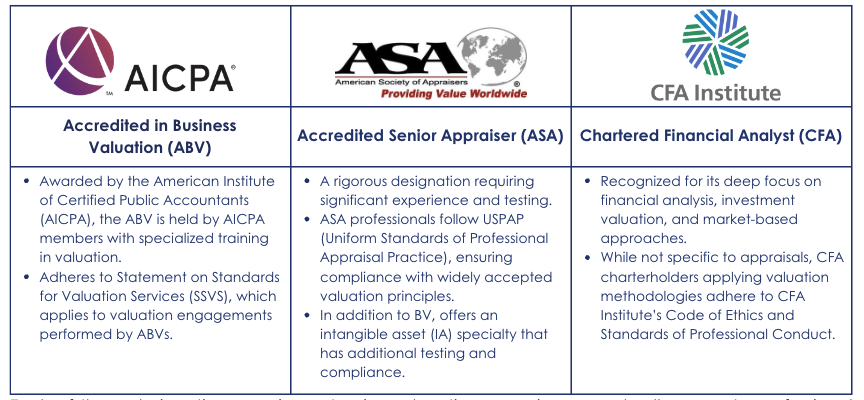
Our appraisers possess the highest certifications in the business valuation industry including the Accredited Senior Appraiser (ASA) from the American Society of Appraisers, Accredited in Business Valuation credential by the AICPA. These credentials are recognized by the IRS for a qualified appraiser.
Why Your Valuation Should Be USPAP and SSVS Compliant
USPAP and SSVS compliance means your valuation meets the highest professional and ethical standards for objectivity and quality. These standards ensure your report is credible, transparent, and defensible in regulatory matters. Complying with these standards, such as the IRS Publication 561 and the “Adequate Disclosure Rules,” to provide a solid valuation opinion with “The Chaffe Difference.”
Protecting Your Legacy Under IRS Scrutiny
The IRS closely examines gift, estate succession planning, and valuations. In particular, when appraising business in accordance with IRS standards, Chaffe appraisers follow Revenue Ruling 59-60. Under this IRS valuation standard, we analyze any appropriate discount for lack of control and discount for lack of marketability. Following these standards helps minimize risk from the IRS, and provides peace of mind under government scrutiny.
Deconstructing the Three Core Valuation Approaches
To determine your business’s Fair Market Value, our firm evaluates the three IRS-accepted business valuation approaches under the professional standards. The Income Approach emphasizes future earnings and cash flow. The Market Approach compares your company to publicly traded companies’ recent sales of similar businesses using valuation multiples. Finally, the Asset Approach analyzes the market value of the assets owned in the business less liabilities. Chaffe provides this comprehensive approach in our succession planning business valuations.
6 Value Drivers for Higher Pricing
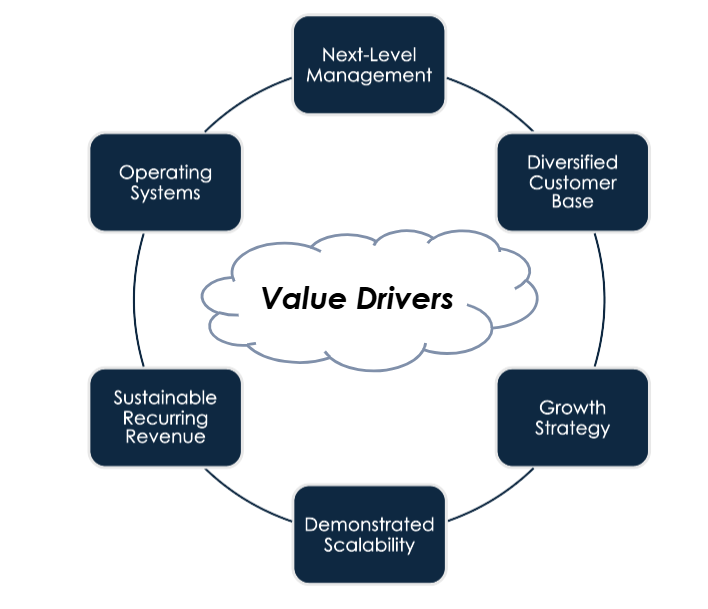
In your succession planning strategy, focusing on these six factors that drive value can increase your valuation multiple, and reduce company specific risk.
- Next-Level Management
- Business purchasers pay a premium for a business that doesn’t rely solely on the owner. Next-level management means having a strong, proven team and documented systems in place. This reduces risk for the new owner, making your company more attractive to them.
- Diversified Customer Base
- Acquirers see risk when a single customer makes up too much of your sales. A diversified customer base means better revenue stability and predictability.
- Growth Strategy
- Buyers want to see a clear, documented path to future profit. A solid growth strategy shows where the new owner can easily find increased revenues, whether through new markets, products, or acquisitions. A compelling growth plan helps foster buyer confidence.
- Demonstrated Scalability
- New owners will pay more for a business that can handle greater sales without needing a huge investment in new staff or equipment. Demonstrated scalability shows that your systems and processes are ready for growth. As a result, the acquirer’s future costs can be reduced.
- Sustainable Recurring Revenue
- The most valuable businesses are those with predictable income and cash flow. Sustainable recurring revenue, from long-term contracts or subscription models, making the target company more attractive for acquirers to purchase.
- Operating Systems
- Well-documented, efficient operating systems (such as processes and technology) prove that your business is not run by guesswork. These systems support consistent product quality, predictable costs, and smooth operations.
FAQs
Cash flow is a key factor, as it measures the money a new owner will actually receive from the business. We perform common adjustments, like addbacks for owner compensation or personal expenses, to show the true free cash flow for the business.
There is no formula approach for a reliable business valuation. Chaffe strongly advises against it, as the correct valuation multiple depends on dozens of specific company factors and risks that a simple formula cannot capture. The IRS generally does not favor a formula approach over proper business valuation approaches and methods (see Rev. Rul. 68-609, and Rev. Rul. 65-192).
EBITDA, or Earnings Before Interest, Taxes, Depreciation, and Amortization, is a commonly used cash-flow metric in business valuation. By removing the effects of financing decisions, tax structures, and non-cash accounting items, EBITDA allows businesses to be compared on a more consistent, “apples-to-apples” basis. As a result, EBITDA is widely used in the market approach to compare companies and transactions and is also a key input in income-based valuation analyses.
Contact Chaffe
Curious to learn more about how Chaffe’s certified business valuation professionals can help you with succession planning for your company? Contact Chaffe & Associates today at (504) 524-1801 or Info@Chaffe-Associates.com to learn more about “The Chaffe Difference.” We are here to help secure your business transfer legacy with a defensible, IRS-compliant valuation.
About Chaffe
Chaffe & Associates, Inc. (“Chaffe”) provides highly specialized investment banking services to its clients including a full suite of transactional advisory services along with valuations for a multitude of needs. Chaffe leverages both core competencies to create a powerful finance firm that always places its clients first. Founded in 1982, its clients range from sponsors, founder-led and family-owned businesses to publicly traded corporations spanning a broad spectrum of industries. For more information about Chaffe and its leadership team, please visit chaffe-associates.com.

Nene Glenn Gianfala , CPA/ABV, ASA-BV/IA
Senior Vice President, Shareholder
nene@chaffe-associates.com